Showing posts with label Kemetic Theology. Show all posts

Wednesday, January 16, 2013

Veracity, Validity, and Polyvalance


So, catching up on my RSS feed I spent a while reading about the Shopping Cart blow up via Devo and then poked around on the general forums to confirm my suspicions and noticed our now almost annual Problems with Reconstructionism blow up on the Cauldron (2013 edition, 2011 edition). This seems to be the time of year when shit goes down in the various Recon communities. Seriously. Both of these are the same argument cloaked in a slightly different forms.

The problem is I don’t think we’re arguing about what we think we’re arguing about...

Wednesday, January 2, 2013

"How do we know Set isn't evil?"


This again. I am at the point where I bite my tongue whenever this comes up. We've been over this. 

 "Yes, but given the myths, how do we really know he isn't evil? How did we end up trusting him and including him in our faith?" 

"Look, I know chaos can be useful, but the chaos in my life certainly isn't, so I would definitely steer clear of him."

The number of times I have heard it. The questions all blend together for me and I can't remember who asked what anymore. I see it mostly on the general forums but sometimes on the House forum as well. The problem is that I can think about this far more coherently and calmly than I can write about it. That’s why I don't answer these types of questions on the forums anymore and why I hesitate to post about it here, but I’ll give this a try anyway because I'm feeling ranty this evening: 

Monday, December 17, 2012

Thoughts on Dejet and Neheh While Caught Waiting


Is it normal to refresh the inbox a thousand times hoping to find out the date and time? The clock on my mantel ticks softly intruding into my obsession laced digital world. It is mechanical, metered, and heedless of atomic time. It comforts me and I close the browser …

Wednesday, December 12, 2012

Festivals of Light


For me, the holiday season blends into a single, extended festival of light— light guiding wise men to the hope of peace, light lasting for an impossible eight days under siege, and light returning after being vanquished at summer solstice.


Sunday, October 28, 2012

Interesting Tangent to the Purity Discussion


I found it interesting that many of the items on the list of things which are widely known to disgust people, as shown in this video, are also on the list of things which negatively affect purity as defined in the Kemetic faith. We spend a lot of time trying to convince people new to this faith that impurity does not equal “bad” or “immoral”. However, if this research done by psychologists is any indication, it may be a losing battle to try and convince people of that. It seems that the emotion of disgust makes us (as humans) more judgmental and conservative in our views and actions:


 I found it particularly noteworthy that one of the experiments showed that even being reminded to wash their hands made people judge certain relatively harmless behaviors as being immoral—much more so than the control group.

 I think this has important implications in how we speak about purity. Maybe we shouldn’t be so surprised when, in the face of so much talk about being clean and “pure” people seem so inclined to swing to the opposite extreme, associate purity with worthiness, and get “purity anxiety” as a result. That seems to be a natural psychological reaction. 

Wednesday, October 24, 2012

Reaction to the Discussion of Purity


Sometimes I sneak into the shrine room like a timid, curious child and just open the doors of the naos slightly to peak at the statues. Sometimes I curl up in the big reclining chair--the one in the corner, next to the shelves that house the library-- and just watch the naos from a distance. It’s curious: how a temple I built with my own hands doesn’t feel much like it belongs to me or is part of my home. It is a place I go, not a place I live. I always feel a bit wrong about going into that place with head held high when I am not in a formal state of purity, but, like a mischievous little girl, I still sneak in and poke at things anyway.

They have never chastised me for it, nor withheld their presence. I mostly get smiles and gentle eyes watching me back. They always seem happy to see me enter that space—especially when I have made myself rare. They seem to think I am clean enough, but still…

Friday, September 14, 2012

I am now officially a Remetj! :D


Remetj.

That was really the only word I needed to see in my e-mail this week to suddenly be having the best week. And now, of course, I have been suffering from a severe compulsion to “READ ALL THE THINGS” on the parts of the forum that I couldn’t see before. But it’s more than that: it’s a step forward in a new world. As the high school I work at winds down from an early homecoming and gears up to start the first “real” weeks of the semester, I face the beginning of another year—one in which nothing is the same for me.

I realize that is an almost redundant statement: if we aren’t trapped in a cycle of stagnation, then things are almost never “the same” as they were in the years, days, or moments before we stopped to think on them. Yet… the timing of things this summer…

My world has changed in a fundamental way on many levels.  The world of Beginner was very different than the world of Solitary Kemetic in ways I wasn’t expecting—and I know that the world of Remetj will be different still from that of Beginner. I eagerly look forward to that change, but even as I overflow with excitement for that new, shiny future which dawns in the east, I mourn the slow fading of a different light as it sinks in the west.

For a long time, I have lived in the world of Mom as Everything—in fact this summer was christened by me as the “Summer of Mom” as soon as I heard the diagnosis in April…but I only called it that until I realized that it's really more correct to say “Lifetime of Mom”. I was so close to her. I can’t say that in words that would do her justice. My world was her. My mother filled a role for me that was as dangerous as it was beautiful: Mom as All, Mom as Other Half. Which makes learning to live in the world of Mom as Ancestor especially hard…

Next Saturday is already day 70.

It doesn’t feel like it’s been that long, and yet, it feels infinitely longer. There is still a hard, sharp edge to the grief, but the wound her death caused has ceased bleeding now and it begins to pull back together as new skin grows to cover it.  That doesn’t mean it hurts any less, or that there won’t be a proverbial scar left behind, just that it isn’t a danger to me anymore. The pain is now a healing one, not a rending one.

I slowly return to myself. My hands go back to beading, my mind goes back to telling stories, and my deeper self goes back to dreaming up new destinies. My gods put tasks before me and the voice whispering within me prods me along the path. I call my brother and my father often; I speak to friends daily—and my heart is beating again. I plan and scheme and go about life in general. I am whole once more. I am hale.

The ancestor shrine is ready. The words of the prayer are already starting to echo in my heart and mind, reverberating in the unseen space I’ve made for her to inhabit when she returns from her journey. I am not certain what to expect. I am not certain what she will be now. I am not certain because, for all I knew of her, I still only knew her as one of the living. She will be different. She will be changed by death. It is my firm belief that all souls are. I welcome that change even as I fear it. I will accept her in any form she takes, but there is no way to prepare for the moment when I first catch a glimpse of her transformed and transfigured self.

So much of life is about not knowing how you will react to things, but finding the courage to keep your eyes open anyway.

A few months ago, I didn’t know how I would react to the Beginner’s class. I didn’t know if I would be impressed or disappointed, satisfied or left wanting, finally connected or more alone then ever… I didn’t know if I could come to terms with the idea of the RPD or if I would be able to accept the Nisut (AUS). Would I feel anything during Senut? Could I really learn to connect with my ancestors? Would I really hear the voices of the other Netjeru if I put Set’s statue away? Could I bear to put his statue away long enough to find out? It was those uncertainties which had kept from applying for the class years before when I first heard of the temple. I only applied this summer because after six years, I had eventually realized that there was no way to know the answers but to discover them by experience.

I wrote here once, a long time ago it feels like, about trust. I have something to add to that:

I trust now.

 I trust the Nisut (AUS). I trust the process and rite of RPD. I trust this community. I trust Senut. I trust my ancestors. I trust all of the Netjeru, when they speak, and I trust Set, even when he is silent. And in all of that trust, I have found what I had not dared to hope for. I am impressed, not disappointed. I am satisfied, not left wanting. I am connected, not alone. I have gained something which was not in the lessons proper but somewhere between the lines:

I am prepared even when I am unprepared. I am ready even when I am not ready. I have learned to put some trust in existence. I didn’t realize that I needed to learn that, and at first, I didn’t realize that I had learned it. Until I thought about it this week when I was buying flowers for the ancestor shrine…

Everything is in balance now. That doesn’t mean it’s perfect or even that it’s comfortable, but it does mean that it is inherently bearable. It doesn’t have to be fair that my mother was taken from me so young. It doesn’t have to make sense that the cancer came back when she had been doing so well. It simply is what it is. The important part is that this terrible thing did not go unbalanced on the scales: there have been blessings along the way to soften the blow (I cannot even fully express how much the beginner’s class, and the HoN community in general, helped in all of this—simply by existing and taking me in and giving me something to hold on to), and there were Names who stepped in to steady me when I started to fall.

 Balance. Fairness. These things are not about individual events and single grains of rice, they are about sums and the weight of the crops against the need for them. The scales dip and soar as they even out, and as long as all eventually returns to the calm, steady equilibrium that makes things functional…that’s really all I can ask for.

Wow. That got overly philosophical toward the end there. I really did start this just to announce that I’m now a Remetj. I suppose that means the title of the post is now a bit misleading.

Sorry about that.  XD

Thursday, September 13, 2012

Grounding and Centering: In Kemetic Terms


Translating the terminologies of general pagan practice into Kemetic terminology helps me make connections and recognize when I already know how to do something but just call it by a different name.

 Case in point: I thought I needed to go back to the basics. Centering. Grounding. Shielding. Things I thought I had lost over time once I drifted away from the neo-pagan scene. But once I started reading up on them again, I came to the startling conclusion that I do more of it than I think I do.

For example, Centering and Grounding are often viewed as separate things in the neo-pagan world. Take this definition from The Pagan and The Pen:

“Grounding links you to the healing energy of the Earth, bringing stability, calm, and awareness of the physical body and the world around you. Centering puts you in touch with your personal power, connecting your mental and spiritual bodies.”

But my Kemetic take on it is that what I’m actually achieving through both of those actions is consciously bringing my souls into alignment—all of them, including the Khat—and being fully present in the world as a unified being. If I do that properly, my shadows cast strongly on the worlds and are sharply defined; I am connected to existence in a fundamental way. My Sekhem flows properly through me and the world around me.

For me, both Centering and Grounding are easily accomplished through Senut. The speaking of the sacred words, the purification, the pouring of libations and offering of incense and flame, the opening of the way between the unseen realm of the gods and the seen world, the mindfulness of prayer, the act of henu…all these things catch the attention of the souls and brings them together in a shared act where each of them has a duty to tend to.

But it doesn’t have to be that complicated. Aligning the souls is basic and intuitive. If I take a few seconds to pause even as I am typing this, close my eyes, and do a “roll-call”, I can feel all the parts—Ka, Ba, Khat, Ib, and Ren—present and accounted for. I can feel the sentient ones gather together calmly in the same, still place and turn their awareness in the same direction-- in readiness to work together. I become a being of one purpose and one nature, a being that can keenly feel the world around me, and my inherent connection to it.

 I am well practiced enough at doing this that I am usually able to find that calm center of self… even when I am under duress. Breath is a call to the center of being, and when breathing alone fails, mindful speech can accomplish the same. (Therapists like to call such mindful speech “affirmations”, but I prefer to call it what it is in my perspective: heka.)

Part of my spiritual “panic” that night some time back was due to the frightening and unsettling realization that I had suddenly become not able to do this myself—that my souls were so “out of whack” as to be coming apart from each other at the seams and I was incapable, through any of the techniques I knew, to pull them back together. (Though in retrospect, there was one thing that I didn’t try: saying my Ren out loud…that probably would have helped, especially if I had thought to do it early on during the crisis. It has helped before with some similar situations, but for some reason, it didn’t occur to me at all in the moment.)

I suppose it shouldn’t surprise me that terminology matters—I find that preciseness in language, especially in naming, is a source of strength and power in both the seen and unseen worlds. So I shouldn’t be surprised that “centering and grounding” is suddenly more meaningful to me, and more obvious in my personal practice, when presented as “soul alignment ”.

And on an almost unrelated note: I just can't get into the tree roots/branches visualization thing for "grounding".

Maybe it’s just me, but if I dig too deep into the ground when intentionally visualizing in the unseen, I find the dead. The duat swells just beneath the surface of our world like a vast aquifer, supplying us water from another layer of existence: metaphorical ground water. It is that body of unseen water from which all things living grow and the living thirst for its depths as much as the dead thirst for the water of our seen world, of our lakes and rivers and oceans. It is reciprocal. It is from death that life springs and it is upon life that death thrives.

 That is a system of energy exchange, yes, but not one I find particularly comforting as a touchstone for beginning ritual work. Ask me sometime about what you find if you dig deep enough—for I have learned that there are some places the living should not go without adequate preparation. And that experience has made me a bit wary of roots.


Thursday, September 6, 2012

An Etheric Anatomy of the Kemetic Soul: Summary

Etheric Anatomy of the Kemetic Soul

Image Creation Process

First I have to say that any image of esoteric conceptualizations is subject to a number of natural restrictions in their usefulness:

1. The limits of a two dimensional format.
2. An inability to adequately represent concurrent realities within a single picture.
3. The artistic ability (or lack thereof) of the creator.

I realize this image is by no means perfect, but the process of making it did help me solidify my thinking. For those who are just joining us and are unsure of what all of this means, or who are referencing this post after the fact, here are the links to the rest of the essays in this series:

Khat and Ka (and Ib)
Ba and Ren
Khaibit and Sahu (and Sekhem)

It occurred to me that rather than restate the information presented in the prior essays (which were already as concise as my personal writing skills allowed me to be) it might be useful to see into the process of thought which went into this image. (This is also a not so subtle invitation for anyone who feels up to the challenge to improve on this image or re-imagine it entirely…as you’ll see, there is a lot I’m still not entirely happy with in my rendition) :

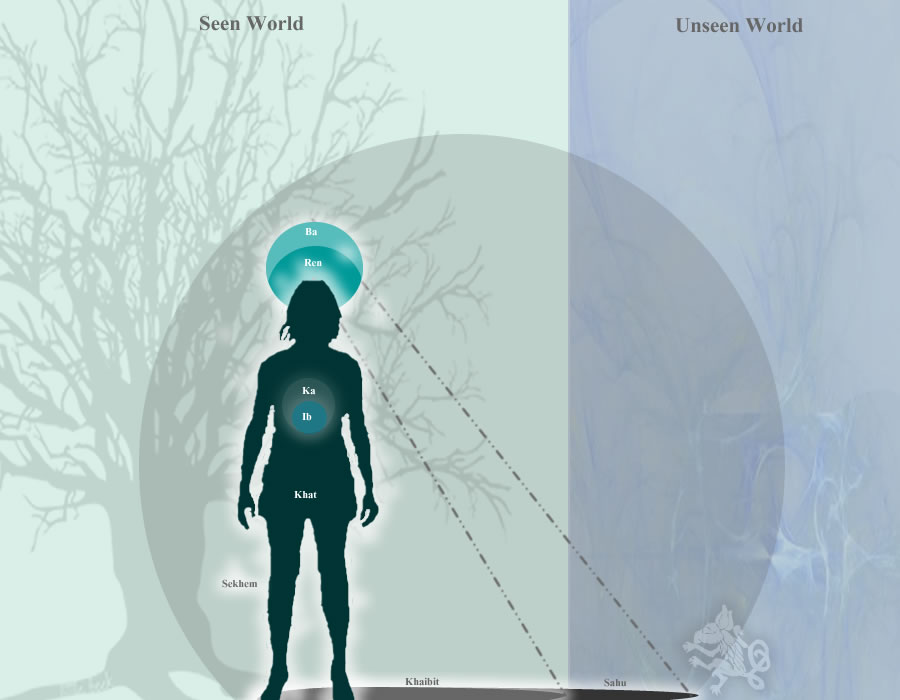
First and foremost, I was attempting to show the various dualities at play outside the usual Ba/Ka duality customarily mentioned in discussions of the soul. The Ka/Khat duality as well as (and especially) the duality of the Khaibit/Sahu seemed, to me, to be more obvious in this format. I hope the intention of the dotted lines to show how the Khat/Ka and Ba cast shadows into the the two realms comes through and doesn’t confuse viewers too much.

[An aside: Did you see how I included the little “unseen creature” to represent how the beings of that realm access us through our Sahu? And the tree added on the seen world side which is a call back to the David Abrahms quote on phenomenology? I was very proud of myself for being that clever. :P ]

I also wanted to show the hidden parallel between the Ka’s keeping of the Ib and the Ba’s keeping of the Ren, hence the similarity in the construction of their nested circled. Unfortunately, to do that, I did have to forsake an arrangement which would have made the Ba’s access to the Ib more obvious.

I placed the Ba/Ren in a way which I hope indicates their inherent ability to separate from the Khat more easily than the Ka is able. I overlapped the circle with the head of the Khat because I wanted to show that the Ba is still an interactive part of the person and that it influences thought even during the day. The reason I didn’t put the Ka/Ib circle in the head itself was partly an issue of space and partly a desire not to overemphasize the head as the “location of souls” and maintain the image of Ib as residing where the heart should reside so the meaning of the term is not completely lost.

I really struggled with how to place the Ren. I wanted to keep the two circles looking similar, again to emphasize the parallels between the responsibilities of the Ba and Ka, but at the same time I couldn’t help feeling that (for most people) the arrangement of the Ba and Ren could (and maybe should) be inverted.  I don’t get the sense that many kau are aware of their Ren. This arrangement makes sense for me, but…I still find myself vacillating on it.

And the Sekhem is represented as glowy-stuff because I wasn’t sure how else to show it.
------
Bonus Material 
------
The Souls Tarot Experiment 

In addition to the image, I toyed a bit with using tarot cards as a means of communicating with the souls. In some ways, this isn’t entirely necessary, since ideally there already is communication between them, whether we are aware of it or not. I was actually less interested in the “Hi there!” form of communication and more interested in being able to ask “All systems go?” before doing mystical work and get individual answers if somepart was harboring an otherwise unobvious no. As with everything else, your mileage may vary in this, but I thought it was at least interesting to try.

 To design the reading, I was thinking about how each part of the soul might best express itself and also decided I was mostly interested in hearing from the “vocal” (read: sentient) souls, aka the Ka/Ib, Ba, and Khat. I decided to do a four card spread arranged thusly:


The idea was to allow each soul to have a chance to speak through the meaning of a single card, though this method could easily be adapted to allow for more cards, and hence more in depth readings. I decided that the best way to make sure the right parts were “speaking” with each card, the method of drawing the cards should be tailored to what each soul would be most comfortable with.

Khat: To my thinking, the Khat is the part of us which is most comfortable with “feeling” physical sensations. So closing one’s eyes and hold the deck in the hands, then thumbing through it and tactilely picking out the card from the deck which has the most appealing physical sensation to it, might be a good way to let the Khat have its say.

Ka: The Ka seems the more visual of the souls, and I would imagine that to draw the Ka’s card, one would be best off fanning the cards out and looking over the back images until one card stood out as visually appealing despite the apparent sameness between them.

 Ba: The Ba’s card could be selected then by having the deck fanned out but the eyes closed and running finger down the fan (without actually touching it) until feeling that intuitive “ping” that is the Ba’s voice (not sure how else to describe that…basically, it’s using the intuition to “feel” the right card) and then looking to see where the finger is pointed when the “ping” occurs.

Ib: The Ib’s card would be selected visually the way the Ka’s card was, but while feeling for a “ping” of the Ba’s intuition. In other words, both the “look” and “feel” of the card should be used to pick the Ib’s card. The idea there is to let the Ba and Ka keep each other honest when consulting the Ib (I’m not sure why I have a gut feeling that doing so is necessary, but I do).  I placed the Ib’s card under and between the Ka and Ba to further reinforce this idea of both Ba and Ka being involved in consulting the Ib.

And that’s basically it. For a deck without reversed meanings, I might be tempted to shuffle indiscriminately and interpret reversals as the equivalent of loudly drawing attention to the meaning of the card. But that’s another gut feeling I can’t adequately explain. If you happen to try this exercise and wouldn’t mind sharing how it went for you, I would love to get input from others—especially if you come up with other ways of selecting the cards. I’m still experimenting with this and would love to try out other ways of doing this that I haven’t thought of :)

Wednesday, September 5, 2012

Khaibit and Sahu (and Sekhem): An Etheric Anatomy of the Kemetic Soul Series


Disclaimer: if you haven't read the first part of this series, or even if you have, allow me to remind you that this is entirely UPG and I am not making any claims of scholarship. Your mileage may vary.
-------

Now comes the part that everyone loves to wax philosophical on: the shadows. Plural, because there are two, and it was that revelation which finally snapped all the pieces into place for me. While the Khaibit is clearly represented as a shadow even in ancient times, the exact nature of the Sahu is less clear. I have seen it translated in many ways, often as the “astral body”, and the word is sometimes used interchangeably with Khat in ancient sources. It wasn’t until I asked the Nisut (AUS) about souls in general that I got my first indication that there was more to it: she described the Khaibit as the shadow cast by the body, and the Sahu as “the shadow that your ba casts in the unseen world”.

 Now, I’ve seen her contradict that statement elsewhere, and I’m sure I’m reading more into it than she personally intended me to, so I’m still going to count what follows as my UPG, while crediting Hemet (AUS) with the origination of the idea—in other words, I mean to give credit where credit is due without claiming that any of this comes directly from her (because it most certainly doesn’t...I took that single phrase and ran with it).

First, let us get past the part that is difficult for those of us who came into the faith from western occultism: the shadows are not “dark”, “negative”, or “repressed” parts of ourselves. In fact, you can take what you know of the Jungian concept of the shadow self and toss it out the window because I’m not even going to touch on it. Plainly and simply, the “shadow self”, to my thinking, would be that place where the Ka and Ba overlap and when neither wants to claim what is left between after asserting themselves… and it would have nothing to do with the actual shadows I’m talking about here.

 Our shadows are representational of the effect of our existence. They are not “souls” in the same sense as the Ba and Ka and Khat—they are not even as close to soul-hood as the Ib—but rather, they are the result of having a Khat and a Ba in a world that interacts with us as we interact with it. They are symbolic of our ability and capacity to act on the seen and unseen worlds.

 The daytime sun shines upon our Khat and a shadow is cast onto the ground. That is our most passive and inescapable action on the physical world. Our ability to cast a shadow means we have the ability to use the Khat to perform physical actions, to interact with the seen.

By the same token, the mysterious midnight sun shines upon the Ba and a shadow is cast on the other world, which is the most passive expression of the our inherent ability to use the Ba to perform actions on and interact with the unseen. It also brings to light something which I hadn’t considered before: we cannot avoid the unseen. We are present in it just as we are present in the seen world. To a degree, we can choose not to act in the unseen, but we cannot avoid casting a shadow there.

That blurs the line between the two worlds, and I know that might be uncomfortable for some, but there is a good reason to pay attention to the shadows even if the ramification of their existence is unsettling: there are recorded heka that effect the shadow(s). If one follows the line of thinking presented above, such heka involving the removal or damage of one shadow or the other would carry with it the sinister implication of seriously injuring one’s ability to act on the world. Protective heka in this regard serves to preserve one’s efficacy as part of the existent. Serious stuff.

Though it would be misleading to not mention here that the shadows alone, as representational (possibly semi-literal) concepts of capacity for action, do not constitute the actions themselves. For it is not only through the shadows that actions are enacted, the shadows merely represent the possibility of action and the effect of existing even when one does not intentionally act. The force of energy and will behind  actual actions, seen or unseen, stems from the divine spark left in each of us after the act of our creation—the Sekhem which infuses us and gives our shadows meaning. It can almost be said of the Sekhem that it is the literal light which casts our shadows, for without that vital force of life energy, we would be unable to act in any capacity.

 [Note: I will not speak too much on Sekhem aside from that, mainly because I am still learning about it and not comfortable making to many definite statements. I may revisit the idea later when I have had more time to experience and work with it.]

Yet, there is also another level of the shadows beyond being our means of interacting with existence: they are also the means through which existence interacts with us. In that way, they additionally function like gateways, two way valves in a sense, which allow us to be experienced by the world even as we experience it. But to understand that concept, we will have to take a detour and go down the rabbit hole that is phenomenology. For a more elegant explanation than I could manage on my own, I turn to David Abrahms, a philosopher and ecologist, who devotes a significant section of his book, The Spell of the Sensual, to describing how phenomenologists describe a living being interacting with its environment and the hidden reciprocity in that interaction:

“He calls attention to the obvious but easily overlooked fact that my hand is able to touch things only because my hand is itself a touchable thing, and thus is entirely a part of the tactile world that it explores…To touch the coarse skin of a tree is thus, at the same time, to experience one’s own tactility, to feel oneself touched by the tree.”

Just as the hand does not feel but for being touched, we do not act in existence but for being acted upon by it. Unfortunately this where my rational mind bends slightly to match the pace of my knowing and I fear that beyond this, I am somewhat less coherent. I will say this of what I learned on that mental road: to reach us in the fortress which is our Khat/Ka/Ib/Ba complex, those who lack a Khat—which is to say, the denizens of the unseen world—must approach us through the personage of our Ba (which alone, is aware of them) and the means of doing so is to tap through the Sahu. For even when the Ba dwells firmly inside our Khat during the day, it continues to cast its shadow on the unseen perpetually simply because it exists.

I have discovered other implications in this, but I freely admit that they are pure conjecture. As an example: it stands to reason that any form of possession by spirits (since the idea is fresh in my mind after reading the Filan/Kaldera book) would naturally come in through the Ba via the Shau, and likely has gaining some control over the Khaibit of the person as its goal. OBEs would, if one takes them at face value, translate into these terms as a temporary separation of the Ba/Sahu from the Khat/Ka(Ib)/Khaibit, with the Sekhem acting as tether.  I could go on, but you probably have a good enough idea of what I mean by now. If nothing else, through this exercise I have at least gained a useful set of terminologies for consistently describing the things I encounter when doing mystical work.

And there you have it: the mysterious shadows explained. :) Next time, I will summarize and tie everything to the image I posted at the start of this. I will also demo and provide instructions for an interesting tarot exercise which I developed in conjunction with this project.

Tuesday, September 4, 2012

Ba and Ren: An Etheric Anatomy of the Kemetic Soul Series

Disclaimer: if you haven't read the first part of this series, or even if you have, allow me to remind you that this is entirely UPG and I am not making any claims of scholarship. Your mileage may vary.

-------


I started my book with a simple goal to write a fantasy novel which eschewed the classical concept of ghosts in favor of something more Kemetic in nature and feel. I knew the shift would be a difficult one for audiences unaccustomed to the underlying philosophy I intended to use, so I focused on imagery in the early part of the tale to set the tone, starting with a glimpse of my atypical vision of the dead, in the very first paragraph of the novel:

“Somewhere amid the bare clacking branches of the trees, the dead fluttered their wings. Ariadne stopped walking; the crunch of her boots in the morning frost echoed into silence. They watched her with unblinking eyes, their bird-forms sleek and unruffled as they waited for her to notice and pay her respects to them.”

I sometimes find myself thinking of my own soul as a bird which, as Ariadne would say “perches behind the cage of my ribs, waiting a lifetime for the chance to fly”.  I have come to believe that as much as we write stories to entertain each other, so too do we write them to better understand ourselves—our stories may not be themselves instructional, but the images should resonate with us and if they do, we may find meaning in them all the same. I think my fantasy vision of “bird ghosts” is not all too far off from how the ba that inspired them functions in actual reality.

As keepers of our intuition, our eternal/essential being, and our true names, the Ba perches within us quietly and ventures out at night, if only briefly, into the world of dreams (one of many spaces in the duat) where they share company with those bau who no longer return to living flesh at dawn. The logic of the Ba is different from the Ka’s logic, which we experience during the day when we are awake, and thus dreams have a fuzziness about them because of the translation between the souls.

When we tap our intuition, the “sense of knowing” that responds is the ba speaking its language, so it stands to reason that those gods who speak to us in waking moments, who speak in that same language of knowing, might do so through our Ba. The Ba is familiar with the Names, after all, since as mentioned, it also keeps the Ren spoken by whichever Netjeru was responsible for its creation. I have heard the Ren called the song that one’s soul sings through the act of living, and if this is true, then I imagine the Ba giving voice to that song. The Ba also casts one of our shadows, our Sahu, into the duat and it is though that mechanism which we see what is unseen.

 [I know I have teased you twice now, but the essay about shadows is coming after this one, I promise.] 

The Ba is the eternal soul (which may or may not have walked in life before, and may or may not do so again after its current life) and it has no sense of linear time—if you have ever lost track of an hour during what started as a fifteen minute meditation, you already know how poor it is at understanding your schedule. The wisdom it gathers, it gathers from unseen places, and it whispers into the Ib those things which guide us through life and make our paths unique. Where the Ka and Khat concern themselves with social and material living respectively, the Ba is obsessed with meaning and originates our feelings of destiny and purpose.

It has been called our subconscious, though I think that is only part of the story, for it is a natural part of our conscious mind as well. I think our creativity and our drive to create is the visceral substance of the Ba that we experience during our waking hours. Inspiration probably finds its source in the Ba as well. For the Ba is also that part of us which responds to poetry and music and art. It is the part of us where hope dwells and where faith resides. It is the part which can fully inhabit the present moment with no regard to past or future, and it is a spirit which can grow larger than the form which contains, and often does during periods of trial and hardship.

The Ba knows the Ren intimately, and thus is familiar with our core being, the desire of our creator, and keeper of the secret of that which transpired during the act of our creation. Because it is keeper of the sacred true name of ourselves, it is the soul which responds most strongly to the speaking of that name.  For though the Ren was spoken at the creation of the Ba, I do not believe that this was the only speaking of the name. I believe it was spoken once again at the seating of the souls.

Full disclaimer: if you haven’t figured it already, I believe in reincarnation. In a Kemetic definition of reincarnation, the Ba must be the soul to travel on though multiple lives, because the Ka, once judged, remains as an Ahku in the duat, eventually returning to the ancestral Ka from which it was born. The Ba is free to incarnate again, and it takes with it the Ren. That is not to say the Ren is unknown to the other souls: we know it is possible for the Ka to discover it, and my UPG is that all of the souls heard it at least once, whether they remember it after the fact or not.

My theory is that the Ren, when spoken the first time, is an act of creation, and when spoken again, is a powerful heka which seats the various souls within a Khat. When a Netjeru speaks the Ren it brings those souls into proper alignment and binds them together in a single life and a single being. Death is the violent and frightening process that it is because it undoes those bonds and disassociates the parts. And this is not entirely conjecture: my UPG about how the Ren functions comes mainly from personal experience.

When I was a teen I sought to know myself. I was told by friends and family alike that I already did. That I was the sum of my parts and that I was already uncharacteristically aware of my inner being. But I could not shake the nagging feeling that something was missing. Something was still beyond my ken. I asked my gods for help, and, on a sudden intuition, pleaded with them to give me my name. To this day, I do not know exactly what possessed me to make that request, but for better or worse, it was granted. I was given knowledge of my Ren, and my life was changed by it.

When Bast spoke of the night she intervened in my moment of crisis, she said “I have stood before you and uttered your name in that moment of darkness which almost claimed you forever.” It was in understanding what she meant by “uttered your name” that I realized what exactly happened that night. I remember the pain of it clearly, the sense of coming apart, of being a stranger in my body and disconnected from my deeper self…the sense of isolation that comes with dissolution of the bonds between souls. When she uttered my name, meaning when she spoke my Ren, she brought the souls which were coming undone back into alignment-- rooting them once more in the Khat, seating them, back where they belonged.

 If that sounds somewhat esoteric and outside the realm of the usual, I assure you it is: the situation is not natural and may have been caused by another instance of me being stupid with my Ren. This is not the first time. In fact, “me being stupid with my Ren” is a recurring theme ever since they gave it to me. This latest incident led to Their insistence on my being instructed in these things so I can learn to be more careful without having to do that learning through experience. (There was, of course, more to what happened that night, but this is the humbling core of it.)

And for the record, I think the Ren functions differently when spoken in the language of the Netjer (and by that, I mean spoken on the tongue of a god, not merely spoken in ancient Egyptian). It certainly functions different for Them than it functions for me when spoken in mortal language, though I won’t deny that there are certain similarities when it is spoken with no specific purpose in mind and outside of formal heka. I have noted that speaking my own Ren aloud offhandedly makes my Ba sit up and take notice in a way which makes it disconcertingly separate from my Ka for a brief instant. But when I speak it casually in my mind, as when I meditate upon the sounds of it, it has the opposite effect: it draws the Ba and Ka closer together so that the boundaries between them grow thin and permeable. Make of that what you will.

And before I get into things too esoteric to be wrapped up within this essay, I will let that mark the end of our discussion of the “body” souls…that is to say, the souls with their own inherent motivations and concerns. The others are more accessories to the whole, embodiments of the natural ramifications of one’s existence. Yes, next time I will finally get around to discussing the shadows and the vital energy. Khaibit, Sahu, and Sekhem. I will also trot that diagram back out and briefly explain how it all fits together in the image. (There may even be a tarot activity to assist one in making contact with the main parts of one’s being). I think I can fit all of that in one very long entry, but if not, I’ll split it into two parts.

Monday, September 3, 2012

Ka and Khat (and Ib): An Etheric Anatomy of the Kemetic Soul Series


Disclaimer: if you haven't read the first part of this series, or even if you have, allow me to remind you that this is entierly UPG and I am not making any claims of scholarship. Your milage may vary.
-----
In the modern parlance, Ka is commonly described as one’s personality and conscience, while the Khat usually doesn’t even get elaboration beyond “it’s your physical body”. On both counts, this is a significant oversimplification, but particularly so in the case of the Khat. I hate to break this to anyone who is still holding onto their western body/mind division assumptions (especially if they are also mired in the body-hate culture), but: the Khat matters. In fact, it is a uniquely important soul to the living. Yes, soul. Not “vessel”, not “soul container”—soul.

The Khat is not just the soul’s vehicle in the physical world. And because I need you to entertain that idea seriously, I will tease you with a bit of the esoteric knowledge you might be denying yourself by thinking of your Khat as unimportant: the Khat is the mechanism which allows the Khaibit and the Sahu, the two shadows, to function (more on that in a later essay).  It is the seat of the other souls, yes, but it does much more than to act as container.

The Khat is the thing which feels the world and moves to the relentless beat of the cycles of life, like the dancer moves to drum beats. It is our physical ancestry—carrying the inheritance of our blood-relatives from one generation to the next. It has a mind of its own. It stores memories of movement in its muscles—as anyone who has learned to ride a bike can attest. It has needs and it speaks its needs through sensation—if we ignore it, it shouts its needs through pain. It fends off illness and makes decisions about which parts of itself are most important to preserve and which parts can be sacrificed in a pinch. We ignore its sentience at our own peril, because it shares with the other souls a responsibility for maintaining the most important organ of our earthly selves: the brain.

And this is where the dualities start to come into play.

We normally think of the Ka as our mind, but in truth, it is only part of our mind (which is also shared by the Khat and the Ba). The place where the overlap with the Khat occurs is obvious even on a rudimentary examination (we even have a cliché—mind over matter—to describe one half of the effect): the mind can have a physical effect on the body, and the body can have a psychological effect on the mind. Even if it is a phenomenon which we give little thought to, it is part of our normal experience as human beings. Most of us have experienced somatic symptoms, such as “butterflies” in our stomach, before a performance or an increase in blood pressure when stressed, and I would imagine that few people have escaped puberty without confronting the ability of hormonal changes to influence mood and decision making. The effect of the body on the mind is clearly delineated in numerous studies, as is the effect of the mind on the body.

For its part, the Ka is the opposite and double of the body. It is the inheritor of spiritual ancestry—a repository of culture and history. It is interesting to note that the Ka and Khat may have different ancestries, because the ancestry of the Ka depends on the family and friends and society that raised you and loved you, while the ancestry of the Khat depends on blood alone, hardcoded into our DNA. However, they blend and meld whether they share an origin or draw two together. In some cases it is impossible to tell the origin of some piece of ancestry: is my tendency toward an obsession with numbers is due to my father’s particular style of parenting and my willingness to learn from him and emulate his behaviors, or to some genetic feature of his line?

Others have written on the familial nature of the Ka, and how it comes to us from those who raised us and how we return to that ancestral Ka when we die. Ka is a gift of the dead, but it is also a personal and present facet of our being: it is that part of us which remembers and which makes decisions leveraging the tool of history against the challenges of the future. The Ka is the part of our personality which learns and applies the knowledge it gains. It is the part that makes the eyes follow the pointing finger of the elder teacher and recognizes the value in pointing the same for others. It holds the responsibility of the will to live and forces the body to move even when the body has given up. It also has a charge which it shares with the Ba: it one of the keepers of the Ib.

The Ib, I think, is the thing which records the actions and intents of the Ka—the subconscious, in a way, but also the ultimate seat of emotions, especially those emotions which exist outside the boundaries of conscious thought. It can be said then, to be both part of the Ka and a thing which can be separated from the Ka during the judgment to examine the life the Ka has lived—hence many heka to keep one’s heart from “speaking against” oneself during judgment. Though it is probably more accurate to say that the Ib resides somewhere between the Ka and the Khat and that the Ba has access to it indirectly.

However one views it, it is the scribe of our being and the Ka is ever mindful of what it writes down. The Ka and Ib converse in a language of emotions unique to the Ib in its role as counselor and advisor.  Righteousness, compassion, guilt, repentance, remorse, validation, shame…things such as these make the language of the Ib. That heavy feeling in our chest when we have trespassed against our morals…that is the Ib speaking to us and the Khat agreeing with it. So too is that feeling of warm content when we have done as we ought, the voice of the Ib, and if it comes with a boundless light and burst of energy, the Ba agrees with it. And what we call being conflicted, that feeling is an argument between the Ka and the Ib.

But here now, you see that I have mentioned the Ba twice already. It is hard to separate the souls when they are bound so intimately to one another. I will leave it here for today and return again to speak of the Ba in its own terms, though I will hardly be able to leave it at that—the Ren may have to feature heavily in that discussion and if I mention the Ren it will ultimately bring us back to the three we have discussed today... *sigh* this is a fair bit harder than I imagined it would be. :/


Just a note after the fact: No, I do not think the Ib is by any means a mystical or infallible moral compass. It think it largely gets its sense of direction from the Ba (which will be part of the discussion next time)

Friday, August 31, 2012

An Etheric Anatomy of the Kemetic Soul: Introduction


When functioning normally, the arrangement of our various souls is seamless. This is an important distinction to make, because I doubt that I am the only one who, upon first hearing about the Kemetic concept of the soul, wrongly assumed that I should be able feel all of the individual pieces… and nearly drove myself crazy trying to because I was almost certain that not feeling them meant something was “wrong”—much as it would be “wrong” if I could not feel sensation from each of my individual limbs. But the reality is that most of our souls are less like limbs and more like organs. Just as we aren’t consciously aware of our lungs—unless we work to be aware of them through breathing exercises or when an illness, like asthma, unavoidably brings them to our attention—we also aren’t often aware of our myriad souls. If they are performing their intended functions correctly, they simply continue to do so without any effort on the part of our conscious selves.

Thus, the topic of etheric anatomy is largely an intellectual one (outside the realms of healing and mystical work). It is also important to note here that, when things do go wrong and draw our attention to our pieces, it is not a matter of the souls themselves being “defective” in any way: I believe that Netjer made all souls perfect. But just as we may fall and break bones, so too may the less physical parts of us be injured by forces in our environment and events in our lives, and just as a broken bone is not a moral comment about a person, a broken soul isn’t either.

For my part, it was trying to understand the long-term ramifications of just such an injury that led me to write these essays. I speak to you from a place of experience, not a place of authority or a place of academia, and it may be useful to keep that in mind so you can put my descriptions in proper perspective: I do not claim that any of this is taken from actual ancient beliefs. It is largely inspiration born of UPG (my own and that of others) and as with all such things, you should take my personal theories with a large pinch of salt, for exactly that reason: they are ultimately personal—your mileage may vary.

I will close this introduction with the two things you’ll need to see from whence this series of essays has been derived: an image and a statement. The statement first, for it encapsulates the core concept of what I learned through my explorations and was the guiding principal for the creation of the accompanying image:

“The components of the soul are balanced against each other such that they are bound to one another through the mechanism of an interlacing set of dualities, and one best learns about them by observing and studying the connections between them.”

And of course, the infamous image which consumed my life for several days as I unpacked its meaning:


A full explanation of everything in this graphic is coming soon, I promise. :)

Next time I’ll be talking about the Ka and the Khat (and to a lesser extent, the Ib) and why they are more complicated then we often make them out to be.

Monday, July 9, 2012

Polyvalance


"I thought I was handling it well--then boils started showing up on my hands and arms. You have to take care of yourself. It will get to you."

I have the fortune and privilege of teaching at the high school I graduated from. My former high school counselor still works at the school, and so when I found out that my mother was dying and that I would need to leave town earlier than expected to spend the summer helping tend to her, I showed up in my old counselor's office. She had lost her mother earlier that year. "It just sucks," she said when I asked what it was like, what I should prepare for, "no matter how old you are, it just sucks." Then, right before I left, she chased me down in the parking lot to give me the above advice, the warning, that no matter how strong we are, the death of a parent is a gut wrenching, hard hitting thing to deal with.

I haven't had any boils, but the night before last night I woke up at 5am as my body shook and what felt like boiling blood raced down the sides of my neck and my abdomen. It was almost like I was a space rocket struggling to take off. My mind was suddenly distant from my physical self and I felt like my soul might flee my body. I felt like I was dying--in fact, I remember thinking that. I remember thinking "So this is what it feels like to die...". It ended almost as quickly as it began.  Then my chest tightened and my stomach heaved. A moment later, my arms went numb and tingly.

I seriously considered the possibility that I had just had a heart attack (I'm very overweight, and I have heart disease in my family, so that's the first thing that came to mind) and I nearly stumbled into my parent's bedroom to ask someone to call 911. But the feeling of impending doom started to fade and I didn't feel like I was in immediate danger of dying so I decided to look up my symptoms online. To my surprise, the Web MD symptom checker didn't kick back heart attack but something I had never considered myself at risk for: Panic Attack.

I was always under the impression that panic attacks involved some sort of panicky feeling and irrational fears--something completely psychological. That's not really true, apparently. Panic attacks are physical events. It's the brain flipping on the body's fight or flight response system at a time when that kind of drastic physical survival mode is not really needed or desired. About 5% of people have at least one during their lifetimes. They aren't usually dangerous, but they are terrifying.

So...mystery solved right? My suppressed fear of my mother's imminent death, and my anxiety over exactly  when it will occur and how I will react, got released in the middle of the night as my brain struggled to cope with a volatile combination of ridiculous levels of stress and sleep deprivation. Just like my counselor experienced boils showing up on her arms. A physical manifestation of a difficult emotional situation.

But...

There was a dream. I was trying to get onto the right bus (not quite the boat from mythology, but the analogy is the same in either case) to travel to the duat. But I couldn't find the right one. I remember that clearly. I remember the shaking started right after one of the attendants told me it was time to leave anyway and we started moving. That's why I woke up thinking I was dying, and why I wasn't entirely surprised until I realized I was awake and that dying in real life hadn't been part of the plan...

There was a reading I did the day before with the "kemetic-oracle-cards-in-progress" deck that I made earlier this month. It had the duat card and akhu card in prominent places. It said I had issues to work through with both of them.

There was the dream later that evening when I tried to nap after I calmed down a bit. A dream where I was in the duat among the dead and speaking with an ancestor who came to me in the form of an old man/tiger who was a father in his life and who said he was desperate for offerings so he could go forth by day with his family, because he was separated from his wife and children somehow--an ancestor who just might be my great-grandfather (the black sheep of our family)...

There was a dream my mother tried to tell me about from the same night--but she couldn't make her brain work long enough to get the story out fully-- it involved being unable to "connect" and not having some kind of "engine" working--which faintly resembles my bus dilemma from my dream just before I started to "die"...

I was raised atheist. Science is king in our household. Science says I had a panic attack, but my spiritual instinct tells me there was more to it than that. What do I believe?

My mind was wrapped around that question as I went to bed. I was worried, because everything I've read says people can develop a panic disorder if they start to fear having an attack, and in turn, cause more of them with that fear--even if the initial trigger was something else. Science told me I should be worried about that. And I was worried, because I was scared. But my spirit told me that my "day-trip" to the city of the dead was what caused all of it, that there was no reason to be afraid, that I just had things to deal with in the unseen. That I could go back to the normal dreamscape I was used to now that the message had been received.

And I thought again...what do I believe in? Which do I put my faith in? Science or Spirit?

I keep forgetting that I don't have to choose. Just as there are double (triple, quadruple, many) truths inside my faith, so are there many truths in the world. Polyvalance. The mechanics of something do not have to define it solely and completely. Just because what I experienced would be labeled by science as a panic attack does not mean that the mechanism of a "panic attack" was not also being used for a specific spiritual purpose. Could this be my psychological/physical reaction to my mother's condition, the endless waiting for death, and my stress boiling over literally in the fell hours of  the night? Of course. And it is that. But it is also more than that. It is also an encounter with the unseen, breaking through in a moment when I was receptive to it. It is all bound up together. There are strands weaving in from both realities. Because one thing can be many things--and in any case, the result is ultimately the same. And the solution to my problem, to the fear choking me and keeping me from sleep, was the same no matter which truth I sided with in that moment...

I pulled my prayer book off the bedside table and I read from it. I read until I felt a sense of peace, of comfort, of acceptance of what would be. Then I turned out the light and went to sleep.

It was a normal night.

Wednesday, June 27, 2012

It's Not Me, It's Us

I remember having an argument with Them once because I do not like to be wrong and because They have enough patience to keep after me until I admit that I am. I had created my first Kemetic oracle deck and pulled cards for a reading. Sixty-nine cards--showing words, not images. One of them? "Daily Ritual".

I didn't want to use the word Senut--though I knew of Senut and knew it existed in the temple and that it was meant to be exactly that: daily ritual. But I hated the idea of it. I hated the idea of being told "This--this here is what you will do to connect with the gods, and by the way? Do it every day."  Even if you don't want to. Even if you don't feel "in the mood". Even if you have other stuff going on. Every day. And I hated feeling like there was that expectation of me--that there was a need to develop some sort of spiritual discipline in me because my own way of talking to the gods somehow wasn't already enough of a dedication on my part.

It's actually a wonder--given how much my less mature self hated the idea--that I included it in the deck at all. I purposefully set out to not have a "daily ritual" in my personal practice. it seemed trite to me to schedule a time to talk to the gods. I talked to them everyday, in a sense, through prayer and devotional art. Why formalize that relationship? Surely, that was something only those who were deprived of that relationship,who had no practice speaking to gods, would do. So I went before shrine whenever I felt like I needed to and was convinced that it was perfectly fine to do things that way. But They had other ideas...

They did not hesitate to nag me with that card. It got drawn every time I did a reading. Every. Damn. Time.

Let me put that in perspective:

There are, as I said, sixty-nine cards in the deck. On a given drawing, I would shuffle the cards very well and draw nine. Even assuming that the first eight cards are not the card in question, thereby limiting the pool of possible cards by eight, the ninth card still only has a 1/61 chance of being the Daily Ritual card, or about a 1.6% chance. For every hundred times I preform a drawing, I should only draw that card at most twice. I have done drawings less than a dozen times and all of them have contained that card.

You think I'd take a hint. But in my usual defiant style, I didn't.

But now, like so many other things, I am reevaluating my stance on it. Here's what I learned once I stopped and listened--really listened--to the temple:

It's not about the expectation. It really isn't. It's also not about the spiritual discipline. It's not a practice meant to make me into a good little Kemetic. It's not meant to change my interactions with the gods or stop me from doing my impromptu ceremonies. Because--and this is the important part--it's not about me.

It's about knitting a community together through a shared act of Heka which draws its power from the forces of exact wording and mass repetition. When one does Senut, one does it as much to contribute to the community as to enrich one's own religious experience.

That's why there is no personalization of ritual words and no free choice in the ritual actions. To use a cliche, there is no I in Team. This isn't about how I talk to the gods--in fact, that's the one part of the ritual which is left open for the practitioner to improvise a bit--it's about how I share in a fellowship which is in diaspora, scattered across the globe. It's the song from American Tale (Somewhere Out There): "And even though I know how very far apart we are/ it helps to think we might be wishing on the same bright star". It's the idea that whenever I say those words, at any time of day or night, there's a chance that somewhere in some remote place, another person is saying those exact same words along with me.

That's...beautiful.

Are there other ways to connect with the gods? Of course. But Senut is about more than that. It's not about me. It's about us.

And that is what I told Them I wanted, after-all.

Sunday, June 24, 2012

Making Room for Ivy

For a long time, there has been one source for me--no...that's not true... a handful...but small enough to have the same affect--and there has been a desire in me to trust that source. Blindly. But ironically, not fully--I hemmed and hawed and half-ignored. It's a phenomena which I have encountered elsewhere...

When we have a student at the Alt. School who needs to really "get" something, to really think about it and process it (something like "you won't be able to graduate on time if you fail this class because you didn't do the big report...so you better start it now before it's too late) It does not do to have one adult say this. It has to be said by every adult that child encounters. We have meetings to manufacture this kind of group nagging mob effect. And it isn't because we think annoying the hell out of the kid will make him do something...it's because we know how easy it is to write off what one person says and how much harder it is to write off what a bunch of people say. That's the concept behind peer pressure, after all. It is easy for any of us to ignore one voice (especially if we have little investment in the relationship with the speaker), but it is a real test of courage and self-confidence to ignore a chorus.

Now, some people would call that manipulative. I call it simple psychology. I think in the US, peer pressure gets a bad wrap.It's not always a positive effect, by any means--especially when it is used to push someone into a dangerous or self destructive action--but like so many other social mechanisms, shunning it out right because it can be dangerous is unnecessarily limiting. We need peer pressure. Because sometimes we are wrong and hearing one person or one source say we are isn't enough to convince us. Especially if we have fostered in ourselves the healthy self-confidence and self-reliance that help us stand up to negative peer pressure and stand by our personal beliefs.

 Sometimes, we need the chorus to remind us that we aren't infallible--to at least plant the seed of doubt which can grow into the tenacious ivy that crumbles our walls. I would be the last to suggest that we should lay down our defenses and shift to meet each new perspective--we wouldn't be ourselves if we did that. As one of my teachers once said, "Our minds should not be so open that our brains fall out". But we shouldn't make our fortress air tight either. Give room for the ivy of doubt to grow, I say, and if it shrivels up and dies before the wall comes down than you are only further justified. It's all about finding out where your real boundaries are.

For me, making room for ivy means hearing many voices and giving them time and attention and good faith. I may not agree when push comes to shove, but I will have at least considered the other point of view.

That is part of why I sought out the temple. There is a richness of voices there. In the lessons and Reverends and books and other members. In the forums and chat logs and websites and the many, many blogs. I add those voices to the others I have been gathering in the last few months. Seeds are planted. Doubts take root and ivy flourishes. Walls I once thought foundational prove to be ornamental and come crashing down.

And I realize now--that is as it should be.

Saturday, June 16, 2012

Trust and Fear


Outside the window of my bedroom there is a highway. Through the tall, south facing windows, I can clearly see a busy on-ramp across from me. Today I have learned a lesson from observing it: I have trust issues.

Now, stay with me…I will get back to that thought in a moment.

I spent today sifting through the blogs of members on the forum, and the blogs linked by those blogs, and so on. I was looking for inspiration (and distraction, truth be told: today was another rough day for my mother, who spent most of the afternoon in pain between wakefulness and sleep). What I wasn’t looking for was fallout from something that happened all the way back in July of 2011.

I won’t repeat the words I read on those blogs here (anyone who knows what that date means can find what I found easily enough), but suffice to say I was worried. In fact, gravely concerned. I have been watching the temple for years but must have been looking the other way when this happened. I don’t recall it at all. I do remember a flood of refugees hitting the general pagan forums, but I never looked to see why they had all left so suddenly. The dozens of other blogs I hunted down and read today (checking the date in question to get a sampling of reactions) did little to ease my concerns.

But what I did next is the reason why I said in my application that I was finally mature enough to take this class: I checked the forum.

Yes. Instead of being my usual self and reacting solely based on the words of others and what they say was said I went and looked to see if I could find out what was said in the first place and hear it straight from the mouth the woman who first breathed it into existence. I was prepared for it to be bad. I was prepared to find something that would sour all of this for me and confirm what I had read elsewhere on the blogs.

But you know what? It wasn’t bad, and I don’t disagree with her. I liked what she had to say. I was comforted by her honesty even in the face of everything people said to her in the aftermath. I respect her declarations and her compassionate response to the criticism of those that challenged them.  

Then there was that insidious voice in the back of my mind…

That still doesn’t change what you really fear. What if it's “wrong”? What if his name is not the one she gives you? What if she says [insert name “I have issues with/is nothing like me”]? Then what will you think of her?

Back to the cars on the on-ramp.

It’s busy on that highway. At all hours of the day and night there is a steady stream of cars. Even more so tonight because it’s Friday and people are headed into the city for happy hour. But despite that, no one on the on-ramp slows down as they approach the bottom. No one. But I would— if I was out there. Because I don’t trust them. I don’t trust myself. I don’t trust chance or fate. I don’t trust luck. I don’t trust. But eventually I do it. Eventually, I merge. 

I asked him tonight. A plastic cup of milk and a bitter chocolate. No candles, no incense. Dripping wet from a shower, in my PJs. I sat there and I challenged him.

What if she’s wrong? What if I’m wrong?

No. What do you need? Aren't you the child who cried under the shrine because she didn't want to be alone anymore? Because she didn't want to be rejected anymore? Because she wanted acceptance and honesty in her relationships with others? Because she didn't want to carry the pain again?

He fixed me. He pulled me out of the darkness and gave me the strength and the courage and the temperament to insist on existing as I was no matter what others said or felt about it. But is his essence the only essence in me? No. Is his voice the only voice I cherish? No—though I do cherish him.

Make no mistake.

 I do empathize with him, and believe strongly in his cause.  I do still thrill a bit when chaos strikes. I do still like to test the mettle of my kings. I do still press my forehead against the glass to watch the storms. I do still get red of heart at times and speak out harshly against injustice and those who perpetuate it and stand spear in hand against the forces of uncreation. I do still do the things others will not do because someone must.

But…

I also write stories and devour knowledge. I also make talismans and hone my skills as an artisan. I also like being with people and belonging to groups. I also teach. I also obsess over death and dying and how it matters to society. I also cast spells. I also like numbers and math and order. I also play video games and watch anime. I also read tarot cards and have been trying to develop a personal deck. I also sing. I also draw. I also see land spirits. I also explore, constantly. I also like liminal spaces and dream worlds and mysteries and true names and…

And…
It goes on.
I am also many things.

I will not question how much he means to me. I will not question how much I have needed him at my side. But when he asks…

Aren’t you the child who cried?

I have to say yes. I am.

Aren’t you the child who pleaded for the thing I could not give?

Yes. I am.

He loved me enough to save me. He loves me enough to let me go... if I need that.

Because that’s the question I’m really asking when I ask “what if she’s wrong?” Because whatever her answer is, I have to trust that she isn’t wrong. Once I get past the trust deal, once I merge my car into this lane running parallel to me, that question doesn’t apply anymore.

What I was really afraid of was the unspoken question underneath it. The question I needed him to answer. 

Will you still love me? 

Will you still need me to? 

I don't know. I don't know...